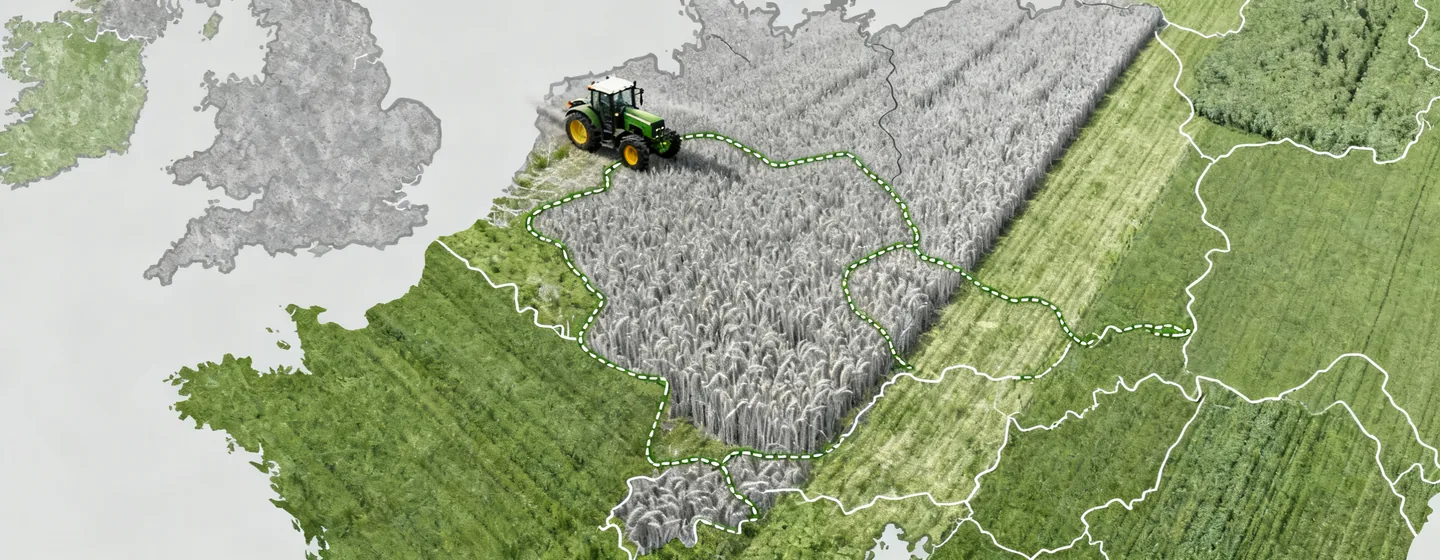
Regional farm application map overlaying tractor routes across crop belts

Applications by region

Match Fendt packages to the crop belt you actually farm

Use the regional tabs to see how horsepower, boom width and forage trains shift between plains row-crop, humid forage belts and mixed livestock valleys.

Plains row-crop programs

Broadacre cereals and oilseeds favor 150–260 hp row-crop tractors with multi-remote hydraulics for planters, plus optional 350+ hp units for deep tillage. Boom sprayers with spray drift control become the throughput tool once blocks exceed a few hundred hectares. Grain moisture targets near 14% drive dryer and cart timing more than cabin features.

  • Coverage planning: 400–2,000 ha seasonal blocks
  • Working width: 9–18 m planters, 24–36 m booms
  • Dispute note: drone spraying helps fragmented edges; boom sprayers still win continuous rectangles

Humid forage belt

Mower, merger and baler trains stress continuous PTO horsepower and bale density consistency. Forage harvester support tractors need stable road transport between small fields. Wet soil windows punish undersized remotes when wrappers and wagons stack.

  • PTO focus: baler and forage harvester continuous demand
  • Bale density: monitor chamber settings against crop moisture
  • Parts: belts and knife pivots staged before first cut

Mixed livestock valleys

Compact and mid-range tractors handle feed, manure and barn approaches. Loader packages and tight turning matter more than maximum drawbar. When orchards or specialty crops share the valley, tire selection and canopy clearance join the RFQ fields.

  • Engine band: 75–150 hp utility class
  • Utilities: document workshop voltage for cold starts
  • Animal welfare housing sites need low-noise loader cycles near barns
Method comparison: drone spraying vs boom sprayers

Procurement teams often ask which platform belongs in the same RFQ as the tractor fleet. Both sides below are valid; the choice follows field geometry, throughput and spray drift control maturity—not a single “best” label.

Drone spraying

Flexible for fragmented fields, terraces and difficult terrain where a 24–36 m boom cannot stage. Useful for edge treatments and spot passes. Limits: battery logistics, lower hectares-per-hour on continuous rectangles, and more operator certification overhead.

Boom sprayers

Higher throughput and more mature rate control for large rectangular or circular blocks. Pair with tractor horsepower and tank capacity (often 3,000 L class and above) in the same RFQ. Limits: headland space, soil compaction risk when wet, and poorer fit on highly fragmented parcels.

Selection rule of thumb: if continuous spray blocks exceed a few hundred hectares with open headlands, boom platforms usually set the tank and remote map; drones remain a complementary tool for edges and inaccessible strips.

Application intensity snapshot

Relative planning bars for how often each program stresses horsepower, PTO and spray capacity. Bars are comparative guides for RFQ scoping, not laboratory results.

Row-crop draft & transport88%
Forage PTO continuity92%
Boom spray throughput76%
Compact loader cycles70%

Route your region into a dealer quote

Tell us the crop belt, hectares and the implement that sets PTO demand. We return a tractor class shortlist with hydraulic and delivery notes.